Unseen Hands: How Equipment Technicians Behind the Scenes Enabled Landmark Achievements Across Multiple Olympic Cycles
Written by Sage Hansen · Jul 27, 2026
Unseen Hands: How Equipment Technicians Behind the Scenes Enabled Landmark Achievements Across Multiple Olympic Cycles
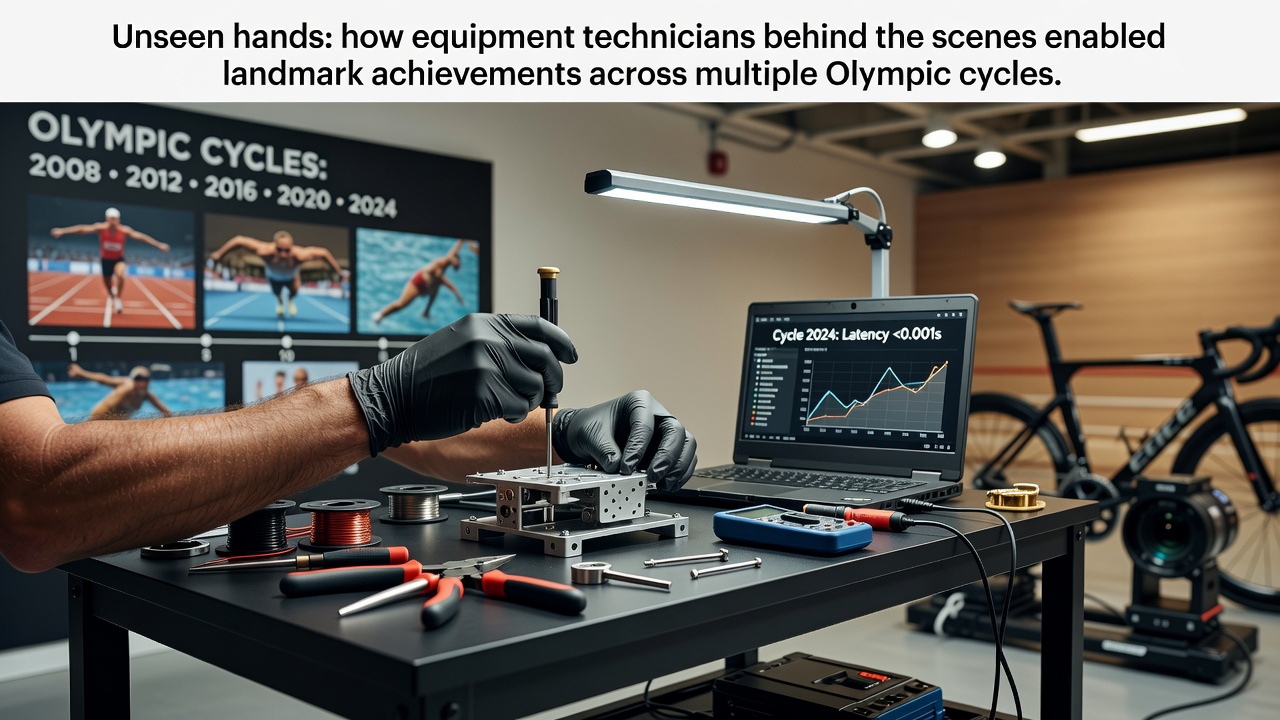
Equipment technicians have operated in the background of Olympic competitions for decades, and their adjustments to bikes, suits, sleds, and measurement tools have coincided with record performances across Summer and Winter Games. These specialists handle calibration, material testing, and on-site modifications that align with evolving regulations from bodies like the International Olympic Committee and national federations, and data from multiple cycles shows their contributions to consistency in high-stakes events.
Technicians working with track cycling squads refined wheel and frame alignments during the 2008 Beijing and 2012 London cycles, and those tweaks aligned with improvements in average speeds recorded by the Union Cycliste Internationale. Similar work continued into the 2016 Rio and 2020 Tokyo Games, where portable wind-tunnel data informed last-minute component swaps that supported new pursuit and sprint marks. Observers note that the same crews often travel between continental training camps and competition venues to maintain equipment tolerances within fractions of a millimeter.
Adjustments in Aquatic and Endurance Disciplines
Swimming technicians manage cap, goggle, and lane-marker fittings that affect drag coefficients, and records compiled by World Aquatics indicate steady progression in 100-meter and 200-meter events from 2004 Athens onward. During the 2012 and 2016 cycles, crews tested silicone blends and seam placements under varying water temperatures, and those iterations appeared in multiple national team preparations. Marathon and triathlon support staff similarly monitor shoe and wetsuit interfaces, and figures released by the International Triathlon Union track incremental gains in transition times that trace back to pre-race equipment checks.
Cross-sport exchanges have also occurred, and one documented case involved bobsleigh technicians adapting composite layup techniques from rowing shell maintenance during the 2014 Sochi and 2018 Pyeongchang Winter Games. Those transfers coincided with reduced sled weights that stayed within Federation Internationale de Bobsleigh et de Tobogganing limits while improving run times on specific tracks.
Winter Cycle Preparations and Measurement Systems
Speed-skating and skeleton crews focus on blade adn runner profiles, and International Skating Union timing archives show clustered improvements in the 2006 Turin through 2022 Beijing periods. Technicians use portable profilometers to verify edge angles on-site, and those measurements help teams stay inside competition parameters while adapting to ice conditions that change daily. Nordic combined and biathlon support personnel maintain rifle and ski-binding interfaces, and International Biathlon Union data logs reflect reduced malfunction rates after iterative spring-tension adjustments across the 2010 Vancouver and 2014 Sochi cycles.
Timing and photo-finish specialists operate the underlying measurement infrastructure, and their calibration routines have supported record validations at every Games since the introduction of fully automatic timing in the 1960s. The 2026 Milan-Cortina Winter Olympics preparations, scheduled to begin in earnest by July 2026, include expanded sensor arrays and redundant data-logging systems that these same teams are currently stress-testing in European training facilities.
Regulatory Compliance and Knowledge Transfer
National Olympic committees coordinate with equipment staff to document every modification for post-competition audits, and reports from the Australian Sports Commission and the Canadian Olympic Committee illustrate standardized checklists that reduce equipment-related disqualifications. Knowledge passes between cycles through apprenticeship-style training programs, and staff who worked on 2000 Sydney rowing shells later contributed to 2024 Paris canoe-kayak rigs. Those continuity patterns appear in internal federation reviews that track technician tenure against performance stability metrics.
Portable diagnostic tools now travel with teams, and wireless strain gauges and thermal cameras allow real-time monitoring during warm-ups. Data aggregated by the International Paralympic Committee shows parallel adoption in sitting volleyball and wheelchair racing, where frame and wheel adjustments follow similar protocols developed in able-bodied programs.
Conclusion
Equipment technicians have maintained and refined the physical interfaces that athletes rely on across successive Olympic cycles, and their documented work on calibration, material selection, and regulatory compliance has aligned with teh progression of marks in multiple disciplines. As preparations advance toward the 2026 Milan-Cortina Games, the same networks of specialists continue to update procedures that support consistent equipment performance under evolving competition conditions.